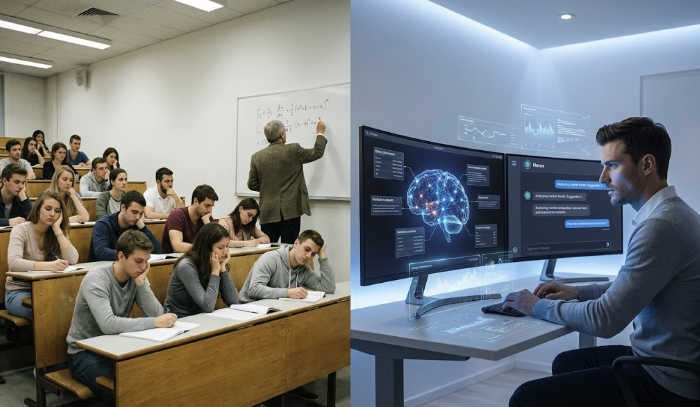

92 million jobs displaced by 2030. That's the number everyone's throwing around now. I hear it and I don't panic — I'm not really the panic type — but I also can't unhear it.
The weird part is that nobody's actually responding to it like it matters.
Universities are having the same conversations they were having five years ago. High schools are pushing the same pathways. Parents are still saying "get good grades, go to college, everything will work out." And I'm 17, so I should probably just nod and keep my head down. But I can't, because the math doesn't work anymore.
What We're Actually Looking At
It's not that jobs are disappearing. It's that the jobs disappearing are the ones people trained for five years ago. By the time you graduate from college in 2028 or 2030, the skills you spent four years learning might be partially irrelevant already.
AI isn't something that will happen later. It's happening now. I can use it to write code. I can use it to design things. I can use it to draft emails and analyze data. And I'm 17 — I have access to the same tools that professional engineers use. The difference between me and someone who got their computer science degree three years ago is basically just time. Maybe not even that.
Universities move in four-year cycles. A freshman in 2024 graduates in 2028. The curriculum they're on was designed to train people for 2024 jobs. By the time they graduate, they're not behind one year. They're behind in capability and adaptability. They learned specific skills instead of how to learn new skills fast.
That's not a complaint about universities. It's just math.
The Generation Problem
My generation — Gen Z, whatever — we're the first generation where the useful skills are changing while we're learning. Not after we graduate. While we're in it.
And the system doesn't know how to handle that.
A kid starting college right now might spend four years mastering frameworks or languages that are already being made obsolete. Or they might go to a trade school and learn something that AI hasn't touched yet. Or they might start working and learning simultaneously, staying adaptable instead of locking in.
The scary part isn't the 92 million number. It's that most people are ignoring it.
I've watched my dad navigate his career, and he did it by staying curious and adaptable. He didn't just take a job and do the same thing for 40 years. He learned new things. He moved when it made sense. He stayed useful because he was paying attention. But the pressure on my generation is way different. We can't afford to be static in a job. We have to be learning constantly.
What I Actually Think We Should Be Doing
Stop pushing teenagers to commit to a four-year plan when the world is moving in two-year cycles. That's not anti-education. I love learning. I read a ton. I'm teaching myself things all the time. But I'm doing it in sprints, not in a locked schedule.
Skills matter more than credentials now. You can prove what you can do. You don't need a degree that says you can do it if you can actually do it. That's not a radical idea — it's just true right now in tech and design and a bunch of other fields.
Stay adaptable. Learn the fundamentals — actual thinking, problem-solving, how to learn — not just the specific tools that are popular today. Those change. The ability to adapt doesn't.
Build something. Anything. Get feedback. Learn what fails and why. That matters more than a 4.0 GPA and a degree in something that's changing shape while you're still in school.
The Real Talk
I'm not telling everyone to skip college. My dad went to Boston College and he's great at what he does. But he also knew why he was going. He had a plan. He was moving toward something specific, not just doing what everyone told him to do.
For my generation, the question is different. It's not "what degree should I get?" It's "what do I need to be valuable and adaptable in 2030?" Those are different questions.
And the answer might be college. Or it might be six months of focused learning and then jumping into work. Or it might be a combination nobody's really figured out yet.
The 92 million number is real. The change is real. What's not real yet is a system that's actually responding to it. Until one exists, I'm figuring out what skills matter, learning them fast, and staying ready for the next thing.
Because 2030 is coming fast, and we're not ready for it yet.
