Finance
Building a Debt-Free Future: A Family's Blueprint
Alex Ortner
March 14, 2026
Look, I'm not going to pretend I had this figured out at 22. I graduated from Boston College with a degree and the vague sense that I should probably figure out how to make money now. I was lucky — I didn't carry student debt — but I also didn't have any real framework for what to do next. A lot of my early decisions were just... decisions. Some worked out. Some didn't. That's kind of how it goes.
But I'm not about to let my kids repeat that pattern.
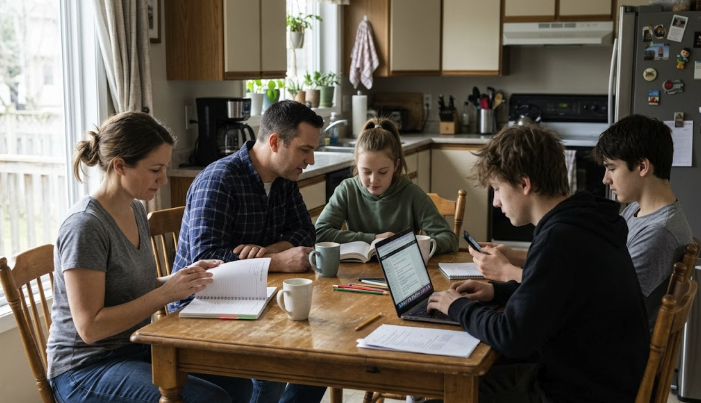
Lucas is 15. Malakai is 17. They're watching how money moves through our house, asking questions about why we make certain choices, and honestly, that's been my biggest wake-up. You can't just tell teenagers "here's how finances work" and expect it to stick. They need to see it happening in real time. They need to understand the why behind the decisions.
It Starts Earlier Than You Think
The biggest shift in our family was realizing that talking about money can't start when they're standing in front of a college bill. It has to start now.
When Malakai was around 14, I started showing him actual numbers. Not to scare him — to show him options. I walked through what happens if you take on $30k in student debt versus $60k versus going to a school that's half the cost. We looked at loan calculators. We talked about what interest really means over 20 years.
The thing that landed with him wasn't the math. It was seeing that money is literally time. If you borrow $50k and spend 10 years paying it back, those 10 years are not free. You're working partially for the bank. Once he got that, something clicked.
Lucas has started a couple of projects already — nothing crazy, just side stuff. But we've made it clear that money he makes now? That can compound. A dollar at 15 becomes more dollars by 25. It's not magical. It's just math and time and not stopping.
What We're Actually Doing
Showing, not telling. I talk openly about our financial decisions. "We're not buying that right now because it doesn't align with what matters to us." "We could afford this, but we're choosing to invest it instead." Not to be preachy — just so they see that money is actually a series of choices.
Letting them earn. Both boys have done work — cleaning, projects, helping with family ventures. The money isn't huge, but it's real. They see their effort turn into actual dollars. That's worth more than a lecture.
Involving them in planning. Malakai knows what college costs. He knows what our plan is for him. He knows his options — full scholarship, community college first, in-state school, trade school, work first. We're not hiding the economics. And importantly, we're not pushing any one path. The point is that he's not walking into a decision at 18 blind.
Breaking the debt cycle. Here's what matters to me: my kids won't feel trapped by debt. If they choose to go to an expensive school, they'll do it with eyes open. If they choose something cheaper, that's just as valid. The goal is autonomy, not a specific path.
The Realistic Part
I'm not going to pretend this is simple or that every family can do exactly what we're doing. We've been fortunate. But I also think some of this doesn't require fortune — it requires attention.
You don't need to be rich to show your kids how money works. You don't need perfect financial health to be honest about economics. And you don't need to push them toward college just because "that's what you do." The world has changed. The paths have multiplied. A debt-free future might look like a degree from a cheap school, a trade certification, a year of work then strategic education, or something we haven't thought of yet.
The point is that they're thinking about it now. They're not shocked. They're not discovering at 18 that college costs six figures. They're not defaulting into a path because no one explained the alternatives.
That's what I wish someone had done for me. Not a guarantee, not a plan handed down, but information. Time. A real conversation about what's actually possible.
---
In our house, we're fixing that. Malakai and Lucas are learning about assets, cash flow, and investing right now — at 16 and 14. We're working through real numbers, real budgets, real conversations about money. Not theory. Not a chapter in a textbook. The actual mechanics of building wealth.
When your kid understands money before they leave the house, you've given them something no school ever will.
2. Sales and Communication
Everything in life is sales. Everything.
Applying for a job? You're selling yourself. Asking someone on a date? Sales. Pitching a business idea, negotiating a raise, convincing your kid to eat vegetables — it's all persuasion and communication.
But school teaches you to sit quietly, raise your hand, and wait to be called on. That's not communication. That's compliance.
I learned to sell out of necessity. When I was building my real estate business, nobody was going to hand me clients. I had to learn how to talk to people, how to listen, how to present value, and how to handle rejection. Books like How to Win Friends and Influence People taught me more about human interaction than four years of college courses combined.
Now we're teaching our boys the same thing. We're building a podcast together, and that's where the real communication training happens. When you have to sit across from someone, ask the right questions, hold a real conversation, and put it out for the world to hear — that's a different level of growth. It's uncomfortable at first. It's supposed to be. That discomfort is where growth lives. And every time they do it, they get a little sharper, a little more confident, and a little more prepared for the real world.
3. Discipline and Health
School teaches you to follow a schedule someone else made. That's not discipline. That's obedience.
Real discipline is waking up early because you have a mission, not because a bell told you to. It's choosing to work out when you don't feel like it. It's putting down the phone and doing the hard thing when every part of your brain is telling you to take the easy route.
And health — physical and mental — is the foundation everything else is built on. You can have all the money in the world, but if your body breaks down, none of it matters.
This is personal for me. Building a business with my brother and sister taught me that mental and emotional health aren't luxuries — they're necessities. Stress, anxiety, burnout — these are the things that destroy people, and nobody in school ever teaches you how to manage them.
In our family, health isn't optional. The boys train. They move their bodies. They're learning that discipline isn't punishment — it's the thing that separates people who dream from people who build.
4. Problem-Solving and Adaptability
School gives you a problem with one right answer. Life gives you problems with no clear answer at all.
When the real estate market collapsed in 2008 and I lost everything, there was no textbook for that. No study guide. No professor to ask. I had to figure it out — adapt, learn new skills, find a new path forward. That ability to pivot and problem-solve under pressure is what eventually led to building a successful business from the ground up.
The world is changing faster than it ever has. AI is rewriting entire industries. The jobs that exist today might not exist in four years. In a world like that, the most valuable skill isn't what you know — it's how fast you can learn something new.
We're raising our kids to be problem-solvers, not test-takers. When something goes wrong with a project or a plan, we don't hand them the answer. We let them sit in the discomfort, work through it, and figure it out. That's how you build people who can handle anything life throws at them.
5. Self-Awareness and Emotional Intelligence
This might be the most underrated skill on the list. And school doesn't come close to teaching it.
Self-awareness is knowing what triggers you, what motivates you, what your strengths are and where your blind spots live. Emotional intelligence is the ability to read a room, manage your emotions under pressure, and connect with people on a human level.
These are the skills that determine the quality of your relationships, your leadership ability, and ultimately, your happiness. And you won't find them in any curriculum.
Malakai experienced this firsthand at Tony Robbins' Unleash the Power Within. Being in that room, surrounded by people doing deep personal work, he started to understand himself in a way that no classroom could have given him. He came back different — more aware, more intentional, more grounded.
As a family, we prioritize processing emotions, managing stress, and staying clear-headed. It's not something most 16-year-olds are doing. But most 16-year-olds aren't being prepared for the world that's actually coming.
The Real Curriculum
Here's what I believe: the five skills listed above — financial literacy, sales and communication, discipline and health, problem-solving, and self-awareness — are more valuable than any degree you can hang on a wall.
These are the skills that build businesses, build families, and build lives worth living. And the fact that the education system ignores them entirely should tell you everything you need to know about where its priorities are.
If you're a parent, you don't have to wait for the school system to catch up. You can start teaching these things at home, right now, today. A book. A conversation. A real-world challenge. That's all it takes to start.
If you're a young person reading this — pay attention to the skills that actually move the needle. Not the ones that earn you a grade, but the ones that earn you a life.
That's what we're building here. And we're just getting started.